 Blog
Blog
 Jan 18, 2026
You wouldn’t use a sledgehammer to hang a picture frame. So why would you use the same ticketing system for a three-day music festival and a Tuesday evening yoga class?
Event organizers often grab the first platform they find, then spend months fighting with features that don’t match their needs. The museum director battles complex seating charts designed for concerts. The festival promoter tries to force camping packages into a system built for single-day events. Everyone wastes time and money.
Choosing the Wrong Ticketing Platform Costs You More Than Money
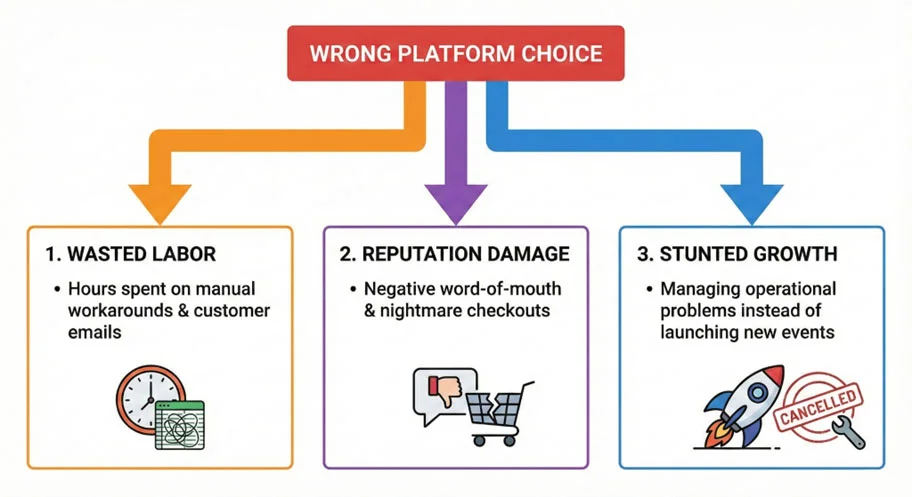
Beyond lost sales, the wrong platform creates costs you won’t see on an invoice:
- Your time. Hours spent each week on manual workarounds, answering confused customer emails. That’s thousands per event in wasted labor.
- Your reputation. Buyers who struggle with checkout tell friends. “Their ticketing site is a nightmare” becomes common knowledge. Recovering from that takes years.
- Your growth potential. While you’re fighting your system, competitors with better platforms are launching new events. You’re stuck managing operational problems instead of building your business.
What most guides won’t tell you: the “best” ticketing platform doesn’t exist. What exists is the best platform for your specific event type. You need to match features to your actual needs. Not the features that sound impressive, but the ones that solve problems you actually have.
So, let’s have a look at what those might be for some of the most common event types.
Concerts, Theater & Live Performances: The Seat Selection Challenge
Anyone who’s sold assigned seating for concerts, theater shows, or comedy clubs knows the “orphan seat” problem. Your sold-out show has seven random single seats scattered through row K. They’re nearly impossible to sell because few people go to performances alone.
In such cases, it’s helpful to use a platform with smart seat selection that prevents orphan seats from forming. When someone chooses two tickets, the system should block combinations that leave a single unsellable seat.
VIP Tiers Can Double Your Revenue Per Attendee
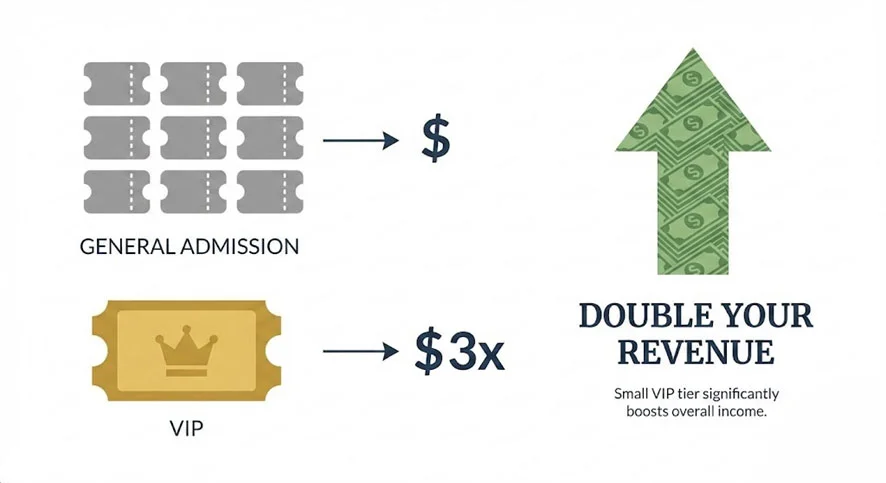
VIP tickets typically cost 2-3x more than general admission, and they still sell out. One in ten people paying double means VIP packages punch way above their weight. But only if your system makes them easy to sell without confusing checkout flows.
TicketsCandy’s unlimited ticket types let you create as many tiers as you want: general admission, VIP, balcony, student rush, early bird pricing. The Ticket Bundles feature packages multiple items at custom prices such as family four-packs, season subscriptions, and VIP lounge access with early entry.
How to choose: Count how many different ticket types and add-ons you need. Some platforms cap you at 3-5 types. If you need more flexibility, platforms with unlimited types save you from artificial constraints.
Entry Day Scanning
Your scanner app needs to work when venue WiFi crashes (which happens constantly when there are so many attendees sharing the airwaves). TicketsCandy’s free iOS/Android scanner app validates tickets in under a second and works completely offline.
How to choose: Ask any potential platform: “What happens to entry scanning when we have no internet?” If they say “you need internet,” that’s a dealbreaker for most live events.
Museums, Zoos & Tourist Attractions: Controlling Crowd Flow
For busy tourist attractions, unlimited entry times equal chaos. Whether you’re running a museum, zoo, aquarium, or escape room, time-based entry scheduling is now becoming standard.
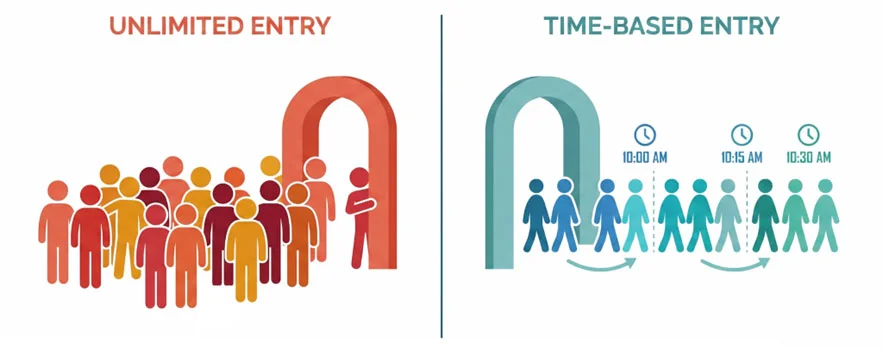
The Dwell Time Calculation Most Platforms Get Wrong
If visitors spend 90 minutes in your museum and you can host 100 people comfortably, you don’t sell 100 tickets every 90 minutes. That creates waves of crowding. Instead, you sell smaller batches (25 tickets) every 15-30 minutes to maintain a steady flow.
TicketsCandy’s Calendars & Time Slots feature handles this elegantly. You can create recurring weekly schedules or custom dates, set how many people per time window, and let the system manage the rest. You can link different ticket types to different calendars (e.g., museum entry, planetarium show, guided tour) and track each separately.
How to choose: Test whether the platform can set different capacities for different time windows. Some systems only do “daily capacity,” which doesn’t help when you need hourly control.
Dynamic Pricing Spreads Demand
Weekday mornings at your zoo? Offer lower prices to fill slow periods. Saturday afternoons when everyone wants to visit? Raise prices slightly.
TicketsCandy’s Smart Rules automates this based on the booking day of the week or remaining capacity. Same venue, different demand, better revenue.
Season Passes: The Gift That Keeps Giving
One annual pass purchase equals 10+ individual visits. Members visit more often, spend more on concessions, and bring guests who buy tickets.
TicketsCandy’s Passes feature handles recurring access with custom validity periods and scan limits. Set unlimited visits, or 12 visits per year, or whatever and the system tracks usage automatically.
How to choose: If you sell season passes, verify the platform can handle scan limits and expiration dates automatically. Manual tracking becomes a nightmare with 50+ pass holders.
The Mobile Reality
According to Arival’s report The Power of Events: How Sports and Performing Arts Drive Tourism, over 35% of tourist attraction tickets are now booked on smartphones, often by travelers without computer access.
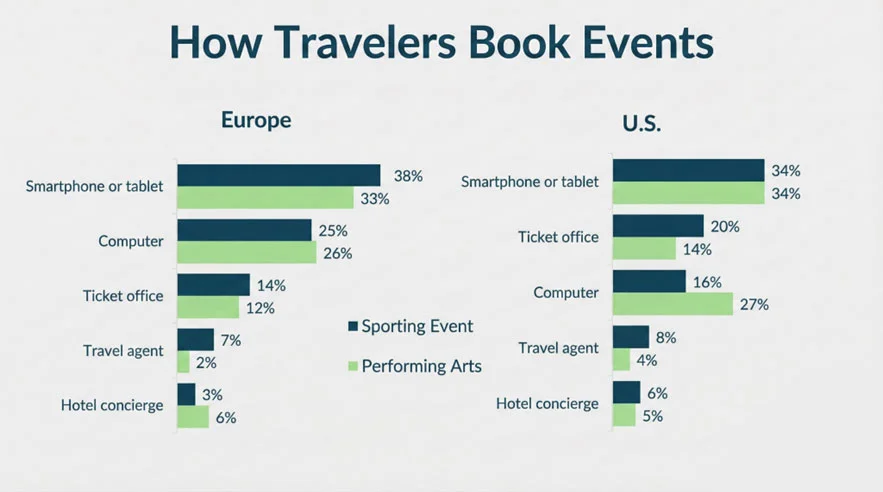
The entire purchase process needs to work on small screens without zooming or rotating. TicketsCandy handles Apple Pay, Google Pay, international credit cards, and digital wallet integration out of the box.
Music Festivals & Multi-Day Events: Complexity Meets Mud
Festivals combine every difficult ticketing problem into one package: multi-day access, VIP upgrades, camping add-ons, merchandise, parking passes, and questionable cellular coverage.
Whether you’re organizing a food and wine festival, Renaissance fair, or holiday festival, you’re dealing with complexity that makes single-day events look simple.
Prepare to be Offline
When 50,000 people arrive at a festival site, cellular networks collapse. Every time. Your entry staff can’t stand there doing nothing while lines back up and angry attendees start yelling about 45-minute waits.
Working offline is essential. TicketsCandy’s scanner app downloads the full validation list before your event. Scan the code, get instant confirmation, done. It syncs back when connectivity returns. Cloud-only scanners that require internet will destroy your entry experience.
How to choose: This is non-negotiable for festivals. Ask: “Can your scanner app validate tickets with zero internet connectivity?” If the answer isn’t a clear yes, keep looking.
How to Bundle Without Creating Inventory Chaos
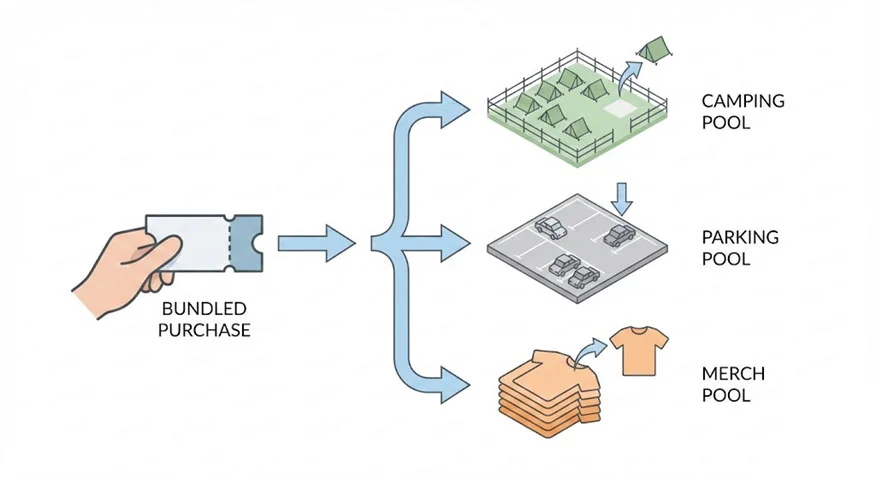
Festival-goers want packages like weekend pass + VIP camping + parking + early entry + t-shirt. But each component affects different inventory pools.
The camping pass reduces campground capacity. The parking pass fills parking lots. The t-shirt depletes merchandise stock. These need to be tracked separately while the buyer pays one bundled price.
TicketsCandy’s Bundles feature explicitly links components and manages inventory correctly. When someone buys your “Ultimate Festival Bundle,” every piece gets tracked separately. No overselling campgrounds or parking.
Add-Ons That Don’t Consume Entry Capacity
Parking passes, locker rentals, and VIP viewing platforms sell alongside tickets, but shouldn’t reduce your main event capacity. A parking pass takes up a parking space, not a festival entry slot.
TicketsCandy’s Add-On Items ticket type handles this distinction. Your festival can sell 50,000 entry tickets but unlimited parking passes because they’re different inventory pools.
How to choose: If your event has add-ons (parking, merchandise, camping), test whether they reduce main ticket inventory. They shouldn’t.
Conferences & Business Events: Data Collection as an Art Form
Conference tickets are structured data records that drive badges, session planning, catering counts, and CME certificates. Whether you’re managing a trade show, networking event, or seminar, you’re collecting way more than “name and credit card number.”
Custom Forms That Adapt to Each Buyer
Not everyone needs the same fields. Academics need university affiliations. Corporate attendees need company names and VAT numbers.
Smart registration forms show relevant fields based on answers. If someone selects “Academic,” show university field. If “Corporate,” show company and tax ID. TicketsCandy’s Custom Questions app adds text fields, dropdowns, and multiple choice during checkout.
How to choose: List every piece of data you collect during registration. Can the platform handle conditional fields and store data per attendee (not just per order)?
Group Registration and Badge Printing
When a company sends 20 people, they shouldn’t fill out 20 separate forms. TicketsCandy’s attendee management lets you add multiple attendees under one order. The company pays once; you get 20 complete registrations.
Modern conferences print badges on-demand. Each badge includes a unique QR code for contactless check-in, session access tracking, and lead retrieval (exhibitors scan badges to collect contact info).
Continuing Education Credit Tracking
Many conferences issue CME, CLE, or other continuing education credits. TicketsCandy’s check-in tracking records when attendees scan into sessions. You can export the data after your event, calculate credits based on attendance duration, generate certificates.
How to choose: If you offer continuing education credits, verify the platform can track individual session attendance, not just event entry.
Community Events & Charity Fundraisers: When Every Dollar Counts
Nonprofits face unique pressure. When credit cards take 3% and a typical platform takes another 10%, that’s real money not reaching your cause.
Whether you’re organizing a fundraiser, gala, community fair, or school performance, watching 13% of every ticket vanish into fees hurts.
Fee Transparency That Actually Helps Your Mission
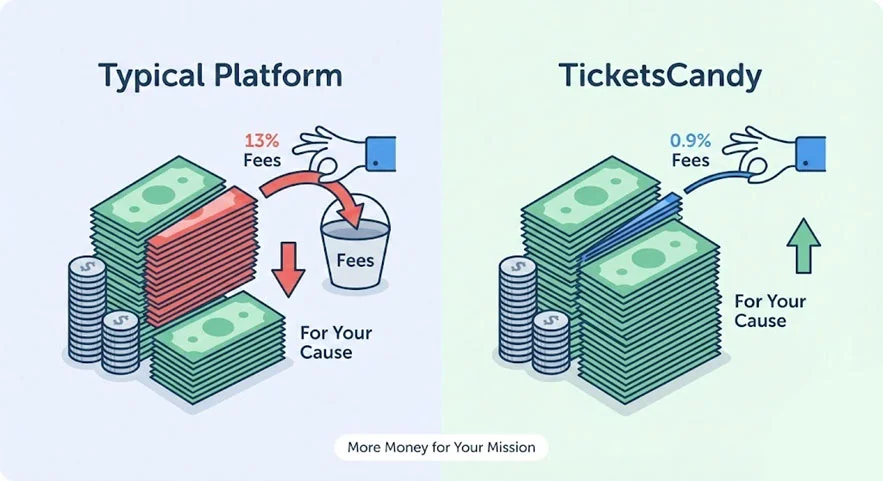
TicketsCandy charges 0.9% (in applicable countries), passed to buyers rather than deducted from your revenue. Point-of-sale through Square has zero TicketsCandy fees.
Compare: a $50 ticket with a 10% platform fee loses $5 per ticket. With TicketsCandy’s 0.9%, you lose $0.45. That’s $4.55 more per ticket going to your mission. Sell 500 tickets? You just gained $2,275. That’s real money paying for real programs.
Donation Integration at Checkout
Someone buying a $50 gala ticket should see a simple option: “$25 more to support our work?” This dramatically increases total fundraising.
TicketsCandy’s Donations ticket type makes this seamless and generates proper tax receipts that separate the ticket value (not tax-deductible) from the donation portion (tax-deductible).
How to choose: Test the donation flow. Can donors add contributions during checkout? Does the system generate proper tax receipts?
Free Tickets and Volunteer Management
Board member comps, volunteer tickets, and sponsor allocations come up constantly. TicketsCandy handles free tickets without charging any fees. The Pay At The Door option lets you reserve spots for people who’ll pay at the event.
Your platform can double as volunteer coordination. Create a ticket type called “Volunteer Registration,” collect shift preferences through custom questions, manage the list through the attendees tab. One system, less confusion.
Workshops, Classes & Recurring Sessions: Series Logic and Capacity Control
Selling a 6-week pottery course requires understanding series, sessions, and resource conflicts. Classes, art workshops, and fitness sessions share this complexity.
Series Ticketing: One Purchase, Multiple Sessions
A workshop isn’t one date. It’s multiple connected dates forming a series. Buy one ticket, access all six sessions.
TicketsCandy’s Passes handle this with date-range validity. Set start and end dates, define how many times the pass can be scanned (6 scans = 6 classes), and the system enforces this automatically.
How to choose: Test whether the platform can limit scans per ticket. Some systems only track “used” or “unused” and can’t handle “used 3 of 6 times.”
Hard Capacity Limits and Waitlists
A yoga studio fits 20 mats. A cooking class has 12 workstations. Unlike festivals, workshops have absolute physical limits.
TicketsCandy’s time slot capacity stops selling when the slot fills. Period. No awkward conversations about fitting 25 people into a 20-person space.
The Waitlist app captures demand when classes fill. When someone cancels, email the waitlist automatically. Classes that would run half-empty after cancellations now stay full.
Resource Conflict Prevention
Let’s say Sarah’s Tuesday evening wheel-throwing class needs Studio A and the kiln. Bob wants to run a hand-building class at the same time. Someone’s getting double-booked unless your system catches this.
TicketsCandy’s calendar logic links different ticket types to different calendars (representing different rooms or resources). The system blocks Bob from booking Studio A when Sarah already has it. No double-bookings, no angry instructors.
How to choose: Test whether the platform can prevent double-booking. Can you link tickets to specific spaces?
Food & Drink Events: Vouchers and Verification
Wine tastings, beer festivals, and food tours have unique requirements. The ticket functions as currency because each includes X tasting vouchers.
Digital Voucher Tracking
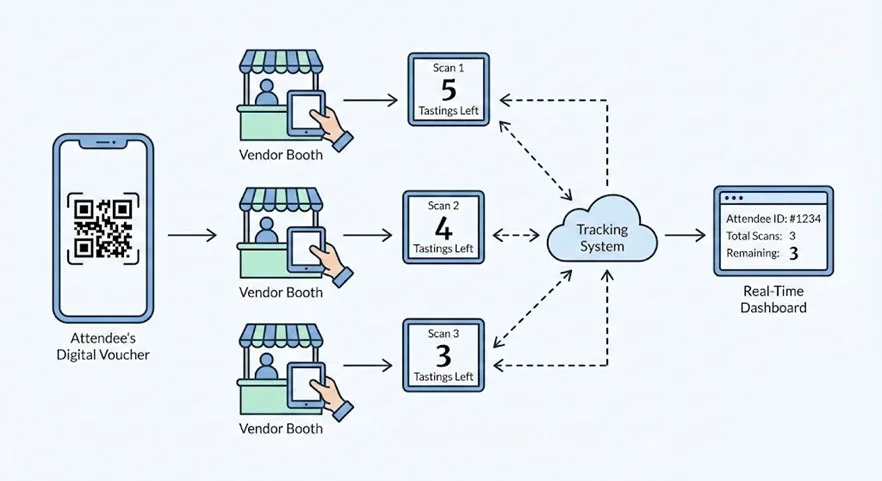
TicketsCandy’s QR codes can be scanned multiple times. The system tracks each scan, so vendors know this person has 3 tastings left (or they’ve exhausted all 5 and should purchase more).
How to choose: Buy a test ticket and try to scan it multiple times. Does the system track each scan separately? Most platforms only allow one scan.
Age Verification
Selling tickets that include alcohol means you’re legally responsible for age verification. TicketsCandy’s Custom Questions app lets you collect birthdates during registration. You verify ID at physical entry, not at online checkout.
What You’ll Actually Get From Making the Right Choice
The right platform doesn’t feel like software. You set it up once, tickets start selling, and you focus on making your event better instead of fighting technology.
TicketsCandy exists because event organizers deserve tools built for their specific needs without paying predatory fees. That 0.9% fee (where applicable) keeps the platform sustainable while being 90% less than typical competitors.
Whether you’re selling out theaters, managing museum traffic, coordinating conferences, or running weekend workshops, the features exist to handle your actual scenario. Your event, your attendees, your venue.
Ready to see if TicketsCandy works for your event type? Sign up for your free account. There’s no contracts, no complicated setup, and no commitment.